



Data for AI teams
Illustration
AI training data services, collected and checked by people
AI training data services collect and prepare the examples a model learns from: speech, photos and text, with their transcripts or tags.
A free call, then a fixed quote in writing. You don't have to go ahead.

The short answer
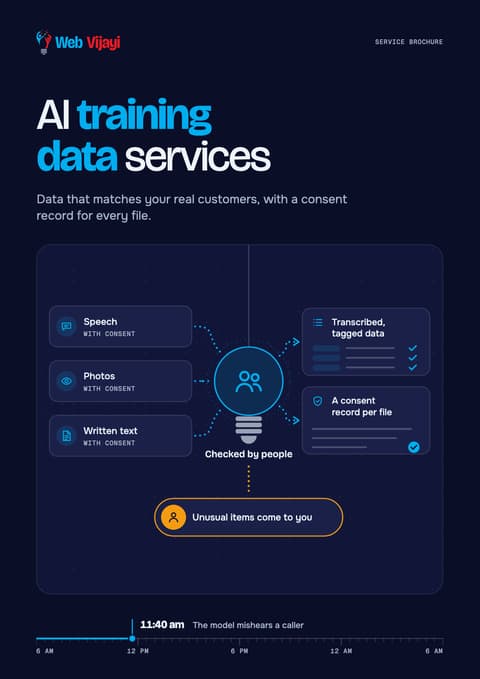
Web Vijayi does this for product and data teams at medium and large companies. People who agreed to take part supply the data, native speakers transcribe and check it, and every file keeps its consent record.
Teams usually come to us when a model does well in testing and badly with real customers, because the data it trained on doesn't look like the people it serves. We gather new recordings, images and text and turn them into data a model can learn from, with transcripts, tags, attributes and context. People do the work and check it, and every batch comes with a written record of how it was made.
Key facts
Your data
Who is it for?
Teams building speech, chat or search features whose model stumbles on regional accents, noisy calls or messages that switch language halfway through.
Retailers and marketplaces with large catalogues where attributes are missing, categories disagree and search cannot find what is in stock.
Companies that must show a regulator or a large customer where their training data came from. In the EU, the AI Act asks providers of high-risk systems to document where their data came from, how it was prepared and how it was checked for bias.
What does the service cover?
Data Collection
We recruit contributors who match the people your model will serve and record what you need: speech, photographs, video, written text or location data. Each person is told what the recording is for and signs a consent that names that use. Consent for one purpose doesn't cover another, so if you later want the data for something new, the contributors are asked again. You get the files, the consent records and a summary of who took part by region, language, age band and device, so gaps show up before training instead of after launch.
NLP for Transcription
NLP, or natural language processing, is software that works with human speech and text. Here, speech recognition writes a first draft, a person corrects it, and a second person checks it. Before any of that, we agree a style guide with you: whether to keep "um" and false starts, how to write numbers, how to mark two people talking at once, and how to spell words that switch language mid-sentence. The transcript becomes the answer key your model is trained and scored against, so every choice in the guide changes what the model learns.
Multi-Lingual and Multi-Ethnicity enrichment
One study of accented English found that a large speech model made several times more errors on accented conversation than on clean American read speech. So we plan collection and tagging by language, dialect, region and community, and native speakers label and check their own language, including the slang and local references a translator would miss. Ethnicity counts as sensitive data under the GDPR and similar laws, so contributors choose whether to share it, and it is stored apart from their recordings. We report quality for each language separately, because a good overall score can include one language that does badly.
Content Enrichment
We tag support tickets, articles, documents and images against a scheme agreed with you first. Each tag has a written definition, one example that fits and one that doesn't. Two people tag the same sample, and where they disagree we find out why and tighten the definition before the rest goes through. You end up with records that search, reporting and models can sort by the topics, products or reasons your scheme names. Product catalogues have a section of their own below.
Data, Product and Contextual Enrichment
For catalogues, we fill in missing attributes such as size, material, colour and what an item fits, map each item to your own category tree and to the categories a marketplace or Google Merchant Center expects, and flag items whose details contradict each other. Contextual enrichment adds what a record means in use: the intent behind a support message, say, or the occasion a product is bought for. Data enrichment does the same for records that are not products, such as supplier or customer lists: we fill gaps from sources you approve, put dates, names and addresses in one format, and flag entries that look like duplicates. Every rule sits in a written guide that you approve.
How does it work?
- We agree what the data must represent. Who the users are, where the model will run, which languages, devices and conditions matter, and what counts as a correct answer. This becomes the written guide.
- We build a gold set. Your experts and ours label a small set of examples together and settle every disagreement. It is the answer key for every later check, because workers agreeing with each other shows they are consistent, not that they are right.
- We run a pilot. One small batch goes through the whole process and you review it before anything scales up. We make any changes to the instructions here, before the full volume starts.
- We work in batches. Each batch is checked against the gold set, and where reviewers disagree we find out why and fix the guide.
- We hand over. You receive the data in your formats, with the guide, the gold set, the consent records and a datasheet.
What you get
Screens are mock-ups
The collected data, with a consent record for every contributor
Transcripts written to a style guide you approved
Tags and attributes in your own categories and file formats
A gold set of checked examples that stays with you
A quality report for every batch: what was checked, what failed and what changed
A datasheet that explains how the data was collected, prepared and checked, and what it should not be used for
You stay in control
You approve the rules before work starts, and you can change them at any point.
Agreed rules in writing.
The style guide, tagging rules and consent wording are yours to approve before the pilot, and every later change is dated.
A report on every batch.
You see what was checked, what failed and what we changed, with examples.
A named contact.
One person on our side answers for the project and brings you anything unusual, such as a recording that captured someone's personal details or an item the rules do not cover.
You can pause or stop.
You can hold a batch, change the rules or stop the work at any time. What happens to data still with us is agreed in the contract.
Where software speeds things up, such as a machine first draft of a transcript or suggested tags, a person checks the work before it reaches you, and you choose whether that means every item or an agreed sample. You stay in control: check it, pause it or stop it at any time.
How is your data kept safe?
Press reports in 2025 described a labelling supplier keeping confidential client instructions in documents anyone with the link could open. So before work starts we agree in writing who can see your data, where it is stored and processed, how long it is kept and how it is deleted at the end.
Ask any supplier, us included, how contributors are recruited, paid and briefed. The Partnership on AI's guidance for this work starts with fair pay, a pilot before launch, clear instructions and a way for workers to ask questions.
What do we need from you?
What the model is for and who will use it
A sample of the data you already have, including cases where the model gets it wrong
Your category tree, file formats and any labelling guide you already use
A subject expert who can settle disputes on the gold set
Your rules on personal data and storage, and the laws that apply to you
Where it fits
Collected data usually goes on to data annotation, and from there into LLM fine-tuning or AI evaluation and red teaming. For product data on a single online store, start with AI for online stores. To store and query the finished data at scale, see big data services. If you also want help building and training the model, that sits with our machine learning consulting.
Price
Every project is quoted in writing after a free consultation, with the timeline agreed in the same quote. The price depends on the type of data, the languages, the volume and how deep the checks go. Full details are on the pricing page.
Download the brochure
AI training data services
Four A4 pages on how it works, what you get, what we'll need from you and the questions people ask, ready to pass round your team.
Sources
- EU AI Act, Article 10: data and data governance (AI Act Service Desk)2026-11-21
- Datasheets for Datasets, Gebru and others, Communications of the ACM2026-11-21
- Partnership on AI, Responsible Data Enrichment Sourcing Library2026-11-21
- Counting on Consensus: selecting the right inter-annotator agreement metric, LREC 20262026-11-21
- EdAcc: the Edinburgh International Accents of English Corpus2026-11-21
- ICO, the lawful basis for web scraping to train generative AI models2026-11-21
- Google Merchant Center product data specification2026-11-21
- GDPR, Article 9: processing of special categories of personal data (EUR-Lex)2026-11-21
FAQ
What is AI training data?
AI training data is the set of examples a model learns from, such as speech recordings, photos or written text, usually with transcripts or tags attached. What those examples cover decides which people and situations the model handles well. A model trained mostly on clean, standard speech will often stumble on regional accents and noisy calls.
Should we buy a ready-made dataset or have one collected?
A ready-made dataset is usually quicker and cheaper when it already matches your users. Custom collection makes sense when your users speak languages or accents, or meet situations, that existing datasets don't cover, or when you need a consent record for every file.
What is the difference between data collection and data annotation?
Collection makes new data: people who agreed to take part record speech, take photos or write text for your project. Annotation labels data you already have. Many projects need both, so collected data usually goes straight on to tagging or transcription. Labelling on its own is covered on our data annotation page.
How do you check that transcripts are right?
We agree a style guide with you first, then build a set of checked transcripts that everyone works to. Speech recognition writes a first draft, a person corrects it, and a second person checks it against the guide. We measure word error rate, roughly the share of words that are wrong, missing or added compared with the checked version, for each language and accent, and report each result separately.
Who owns the data and the consent records?
Ownership and licence terms are written into the contract before any work starts. The consent records travel with the data, so you can show where every file came from and what each person agreed to.
Can the work meet GDPR, the EU AI Act or India's DPDP rules?
Those laws set rules on consent, purpose and record-keeping, and the EU AI Act asks providers of high-risk systems to document where training data came from and how it was prepared. We write the consent wording, records and datasheet to fit the laws we agree with you, and your legal team approves them. We are not your lawyers, so the final legal view stays with them.
Next step
Tell us where your model goes wrong and send a small sample, and we'll suggest what data would fix it. We'll also list the questions we need answered before we can quote.
Book a free consultationLast updated