






Support and back-office teams
Illustration
Outsourced lead qualification: fast replies and sales-ready leads
A team that replies to new leads quickly, qualifies them against criteria you set, hands sales-ready ones to your closers and looks after renewals.
A free call, then a fixed quote in writing. You don't have to go ahead.

The short answer
Outsourced lead qualification gives your new enquiries to an outside team that calls, emails or messages them quickly, asks the questions you agree in advance, and passes the leads that fit to your closers with notes in your CRM. Web Vijayi runs these teams for companies that sell to other businesses and whose sales people can't call every enquiry back in time.
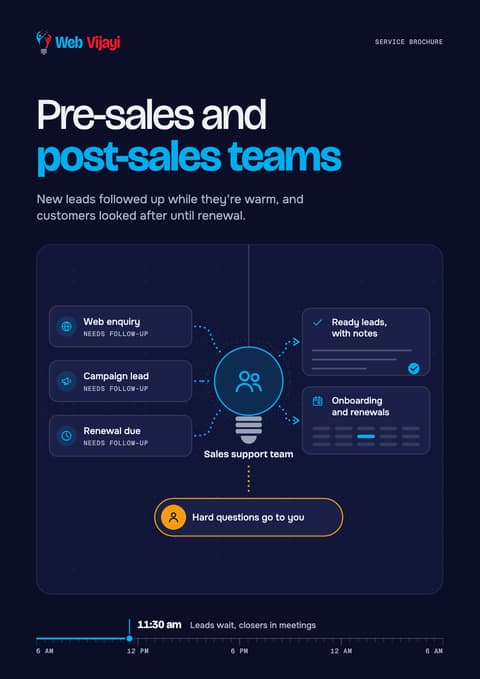
The pre-sales team can book the buyers who are ready straight into your closers' calendars. A post-sales team takes over once the contract is signed. It gets each new customer started, checks in against a plan, collects feedback and looks after the renewal. Both are outsourced teams of people who work to rules you sign off, with a named lead who reports to you.
Key facts
Who is it for?
Medium and large businesses whose sales team can't keep up at one end of the deal or the other. Enquiries from campaigns, events and the website arrive faster than anyone can call them back, so good leads go cold while your closers are in meetings. Or customers sign, hear little for months, and the first real conversation is the one where they ask to cancel.
It suits companies that sell to other businesses, or sell anything a buyer thinks hard about before saying yes, and that already have a CRM and a sales process worth following. If you'd rather your own staff did the follow-up with better tools, marketing automation may be the better place to start. If many enquiries arrive while your office is closed, a chatbot that captures enquiries at night can take the details down so the team has them ready to call back.
What does an outsourced lead qualification team do?
Our pre-sales teams contact each new enquiry by phone, email or message within a reply time you set, because enquiries go cold quickly. The team asks the questions on your qualification checklist and sends each lead one of three ways: to your sales team with notes on what was said and the next step, back into planned follow-up if the timing is wrong, or closed with a reason if it isn't a fit. You and your sales head write that checklist with us, including what your closers should turn down, so nobody argues later about what "qualified" meant.
The caller is often the first person your buyer speaks to. A Gartner survey reported in March 2026 found about two in three business buyers would rather buy without a sales rep, yet they still want a person when choosing a supplier. So the team learns your product well enough to answer plainly, and passes anything it can't answer to your people.
Calling rules depend on where your buyers are. In the UK, business numbers are checked against the Telephone Preference Service and Corporate TPS registers (the national do-not-call lists) before a marketing call, and calling back someone who asked to hear from you is treated differently from a cold call. In India, promotional calls must come from 140-series numbers, made by a business registered with its telecom provider, and they respect each person's Do Not Disturb choices. The UK regulator says a business that asks another firm to call for it can share the responsibility, so our contract sets out who checks what.
What does a post-sales team do?
Our post-sales teams look after customers from the signed contract to the renewal. In the first weeks the team works through an onboarding plan agreed with the customer: what they bought it for, the milestones, and who does what on each side. Gartner research from January 2026 says mistakes early on delay the point where a customer sees value and make them doubt the purchase, and that doubt can end in a cancellation.
After that, check-ins follow the plan rather than a fixed calendar. The team watches facts you already hold, such as product use, open support tickets and whether the people who signed are still involved, and calls when something changes. Renewal conversations start well ahead of the date and include the people who decide the renewal as well as the day-to-day users. When a customer is getting value and needs more, the team raises the upgrade or passes it to your account manager, whichever you prefer, and writes up what customers say for your sales and product people. If your existing customers mostly need help with technical problems rather than onboarding and renewals, support for existing customers is the better fit.
How it works
We learn how you sell today.
Where leads come from, what your CRM holds, how your closers work and when renewals fall due.
We write the playbook with you.
It holds the qualification checklist, call and email guides, hand-off rules, the onboarding plan and the calling rules for each country. Nothing goes live until you sign it off.
We train the team.
They learn your product and your customers, and your people listen to practice calls before any real buyer is contacted.
We start with a pilot.
The team takes an agreed share of your leads or accounts, so you can compare the results with how things work today.
We run it, report and adjust.
You get a weekly report and a monthly review, and we change the playbook when your offer or your market changes.
What you get
Screens are mock-ups
A written playbook of qualification rules, call and email guides and hand-off rules, signed off by you
A pre-sales team that contacts new enquiries within the reply time you set
Sales-ready leads handed to your closers in your CRM, with notes on what was said and the next step
Planned follow-up for leads that aren't ready yet, and a recorded reason for every lead that's closed
An onboarding plan for each new customer, with goals, milestones and who does what
Check-in and renewal calls planned from your renewal dates, starting well before each one
Customer feedback written up for your sales and product people
Quality checks on recorded calls and emails against a scorecard you agree
A weekly report and a monthly review with your named account lead
How do you stay in charge of the work?
Some things stay with you whoever makes the calls: your product, your prices and the promises in your contracts. ISO 18295-2, the international standard for companies that use contact centres, makes the same point, so the playbook says plainly what the team may promise and what it passes to you.
You sign off every script, email template and checklist, and you can change any of them through your account lead.
One named account lead answers to you and is your first call for anything.
Calls are recorded where the law allows, and you can listen to any of them.
Your people can join the calibration sessions where we score the same calls together, so "good" means the same thing on both sides.
The team works inside your CRM with its own logins and only the access it needs, and your customer records stay in your systems.
You can pause a campaign or the whole team, and the contract states the notice period for ending the service.
What we need from you
A written description of the customers you want, and the questions that decide whether a lead is ready
Time with your product or sales lead to train the team, and a demo account or product access
A CRM login for each team member
Where your leads and contact lists come from, and the consent records that go with them
Your renewal dates and the parts of customer contracts the team needs to know
One person on your side who signs off scripts and comes to the monthly review
Price
We quote every team in writing after a free consultation, based on the work, the hours of cover and the size of team you need, and we agree the timeline in the same quote. You'll find how quotes work on the pricing page.
Download the brochure
Pre-sales and post-sales teams
Four A4 pages on how it works, what you get, what we'll need from you and the questions people ask, ready to pass round your team.
Sources
- ICO, Business-to-business marketing2026-11-21
- ICO, What are the rules on live direct marketing calls?2026-11-21
- TRAI, Press Release 91/2026 (10 July 2026)2026-11-21
- BSI, ISO 18295-2:2017 Customer contact centres, requirements for clients2026-11-21
- Digital Commerce 360, Gartner: B2B buyers favour rep-free purchasing (17 March 2026)2026-11-21
- Gartner press release, 20 May 20262026-11-21
- TSIA, Customer success playbook (updated 23 April 2026)2026-11-21
- Gartner research abstracts on onboarding and renewal (January and November 2026)2026-11-21
- TSIA, The State of Customer Success 20262026-11-21
- Scale Venture Partners, SDR qualified lead definition and handoff2026-11-21
- ICMI, Calibration across contact centre teams2026-11-21
FAQ
What is the difference between pre-sales and post-sales?
Pre-sales covers everything before the deal: answering new enquiries, asking the qualifying questions and booking meetings for your sales team. Post-sales starts at the signature, with getting the customer started, regular check-ins, renewals and feedback. You can have one team or both, working from the same customer records in your CRM.
How is lead qualification different from an SDR team?
An SDR (sales development representative) role often includes cold prospecting as well. Lead qualification works with leads you already have: enquiries from your campaigns, events and website.
Which framework decides that a lead is ready for our sales team?
BANT checks budget, authority, need and timing, and MEDDIC adds deeper checks for complex business sales, but many companies use their own scorecard. Ours is a written checklist that you and your sales head agree with us before launch, including what your closers should turn down. Each lead then goes to sales with notes, back into follow-up, or is closed with a reason. If a lead doesn't meet the checklist, your team can send it back.
Who owns the customer data?
You do. The team works in your CRM and your systems, so every record and note stays with you. The contract sets out how the data is protected, who can see it and what happens to it when the work ends.
Can an outside team sound like us?
Yes, with your scripts, product training and call reviews. You sign off every script before it's used, and you can change it through your account lead. Where calls are recorded, you can listen to any of them and correct the tone early, and your people can join the sessions where we score calls together.
How is outsourced lead qualification priced?
We quote in writing after a free consultation. The price depends on the work, the hours of cover and how many people the team needs. Across the market, providers charge per team member, per qualified lead, per meeting, or a base fee plus a bonus, and paying per lead only works with a written definition of a qualified lead.
Related
- Customer support outsourcingCustomer support outsourcing for phone, chat and email, run to your rules
- Phone support teamsPhone support outsourcing: a trained team for your customers' calls
- Chat and email supportEmail, chat and ticket support teams that work to your rules
- Marketing automationMarketing automation agency for lead nurturing and scoring
- AI-assisted CRMA unified agent desktop: one screen for every customer conversation
- Analytics and insightsQuality assurance on every call, chat and email

Pictures are illustrations






Next step
Tell us where deals stall today, before the first call or after the signature, and we'll suggest where a team would help first. If you have a recent month of lead and renewal data, bring it along.
Book a free consultationLast updated