






Support and back-office teams
Illustration
Collections and revenue cycle teams that get you paid and keep customers on side
Revenue cycle management and debt collection are both about getting paid what you're owed.
A free call, then a fixed quote in writing. You don't have to go ahead.

The short answer
For healthcare providers that means unpaid and denied insurance claims, and for lenders and other businesses it means overdue payments. Web Vijayi runs both as outsourced teams for hospital groups, clinic chains, billing companies and lenders, working in your systems to scripts and rules you sign off.
Revenue cycle management is the work of turning a hospital's or clinic's care into money received: checking a patient's insurance before the visit, sending clean claims, chasing the unpaid and denied ones, and helping patients settle their share. Digital debt collection does a similar job for lenders and other companies that are owed money. It reminds customers before a payment is missed, and once one is, it calls, messages and sets up payment plans. Both are run by teams of people who work within the law that applies to your customers.
Key facts
Who is it for?
Medium and large organisations where money owed piles up faster than their own staff can work it. In healthcare that means hospital groups, multi-site clinics, diagnostic chains and the billing companies that serve them, where unpaid claims sit in a queue until they're too old to chase. In lending it means banks, NBFCs and fintech lenders, and the same problem turns up at utilities, telecoms and subscription businesses: customers who are a few days late slide into real arrears because nobody reached them in time.
It also suits a business that has been let down by a collection agency before, with complaints, harsh calls made in its name, or reports that said little about what was done. If most of your work is reading claim forms and invoices into your systems rather than chasing payment, start with document processing instead. And if you want to know which accounts are likely to pay late before they fall behind, forecasting late payments from your own payment history is a separate service.
What does revenue cycle management cover?
HFMA, the US healthcare finance association, groups its 29 standard revenue cycle measures into five areas: patient access, pre-billing, claims, account resolution and financial management. Patient access is registration, insurance checks and authorisation before treatment. Pre-billing and claims mean capturing every charge, coding it and sending a claim that passes the payer's checks with no manual fixing, which the trade calls a clean claim. Account resolution is the follow-up, where payments are posted, unpaid claims chased, denials appealed and patient balances settled.
Denied claims need a team that looks past the single claim. HFMA's guidance counts the first denial on each claim, by number and by value, and tracks how long appeals take and how many succeed. Our teams log every denial by its cause, appeal the ones worth winning, and report the causes that keep coming back, such as a missing authorisation or an eligibility error, to the people at the front desk or in coding who can stop them.
You choose which parts we take on, from the whole cycle down to one stubborn piece such as claims that have gone unpaid for months. For US providers, HIPAA counts anyone doing billing or claims work for you as a business associate, so we sign a business associate agreement before we see any patient data. It covers safeguards, breach reporting, the terms for any subcontractor, and the return or deletion of the data when the work ends.
What is digital debt collection?
Digital debt collection reaches customers on the channels they already use, such as text messages, email, WhatsApp and phone calls, and makes paying easy with a payment link or a plan. The work starts before a payment is due. A reminder ahead of the due date and a call soon after it give a customer the chance to pay before the account falls into arrears. A customer who can't pay in full is offered a plan inside limits you set, and anyone who mentions illness, a bereavement, losing their job or another hardship goes to a trained person.
We contact your customers in your name, as part of your own collections, unless we agree otherwise. The rules where your customers live shape every campaign, for example:
India.
RBI rules allow recovery calls only between 8 a.m. and 7 p.m. and ban intimidation of any kind. Amended RBI directions for banks, NBFCs and housing finance companies take effect on 1 January 2027. The version for banks keeps those contact hours unless the borrower asks otherwise. It also requires banks to record recovery calls, tell the borrower about the recording, keep recordings for six months, name their grievance officer in recovery messages and use only agents who hold the IIBF certificate.
United States.
Regulation F, which governs debt collectors, presumes a collector is within the call-frequency rule if it calls no more than seven times in seven days about a debt, and not within seven days after a phone conversation about it. Calls before 8 a.m. or after 9 p.m. local time count as inconvenient, and every email and text has to offer a simple way to opt out.
United Kingdom.
FCA guidance expects firms to spot customers in vulnerable circumstances, train staff to respond to them, and check that those customers get fair outcomes.
How it works
We study your book.
You share an extract of open claims or overdue accounts with their age, value and contact history, and we show you where the money is stuck and why.
We write the playbook with you.
It holds the scripts, message templates, contact limits for each country, the payment plans the team may offer, the hardship and complaint routes, and the point where an account goes back to you. Nothing goes live until you sign it off.
We sign the agreements and set up access.
Data protection terms come first, including a business associate agreement for US patient data. Then each team member gets their own login with only the access the work needs.
We train the team and start with a pilot.
Your people listen to practice calls first. Then the team takes one agreed slice, such as one insurer, one age band of accounts or one loan product, so you can compare the results with how things run today.
We run it, report and adjust.
You get a weekly report and a monthly review, and we update the playbook when your policies, your payers or the rules change.
What you get
Screens are mock-ups
A written playbook of scripts, message templates, contact limits and escalation rules, signed off by you
Worklists that put unpaid claims and overdue accounts in order of age, value and next step
Denied claims worked by cause, with appeals sent and repeat causes reported to the teams who can fix them
Reminders by message, email and phone before and soon after each due date, each with a simple way to pay
Payment plans set up within limits you approve, with hardship and vulnerable cases passed to a trained person
Every call, message and promise to pay recorded in your own system
Quality checks on recorded calls and messages against a scorecard you agree
A weekly report on money collected, ageing and complaints, and a monthly review with your named account lead
How do you stay in charge of the work?
Your regulator holds you responsible for what an outsourced team does in your name. The RBI says it plainly for lenders, who keep "the ultimate responsibility" for outsourced work, recovery agents included. So the controls below are part of the service from the first day.
You sign off every script, message template and payment-plan limit, and any change goes through you.
One named account lead answers to you and is your first call for anything.
Calls are recorded where the law allows, and you can listen to any of them. Your people can join the sessions where we score calls together.
Every complaint is logged and passed to you with the call or message attached.
You can stop contact on a single account, for example when a customer disputes the debt, and you can pause a campaign or the whole team. The contract states the notice period for ending the service.
The team works in your systems with its own logins. When the work ends, its access is removed and any data we hold is returned or deleted as the contract says.
What we need from you
An extract of open claims or overdue accounts, with age, value and contact history
Your policies on payment plans, settlements, hardship, write-offs and complaints
For healthcare: your payer contracts, the denial reasons you see most and access to your billing system
For lending: the loan terms, your recovery code of conduct and your grievance officer's details for recovery messages
Consent records, contact preferences and your do-not-contact list
A login for each team member, and one person on your side who signs off the playbook and comes to the monthly review
Price
We quote every team in writing after a free consultation, based on the work, the number of claims or accounts and the hours of cover you need, and we agree the timeline in the same quote. You'll find how quotes work on the pricing page.
- Paid separately
- Calling and messaging charges, if any
Download the brochure
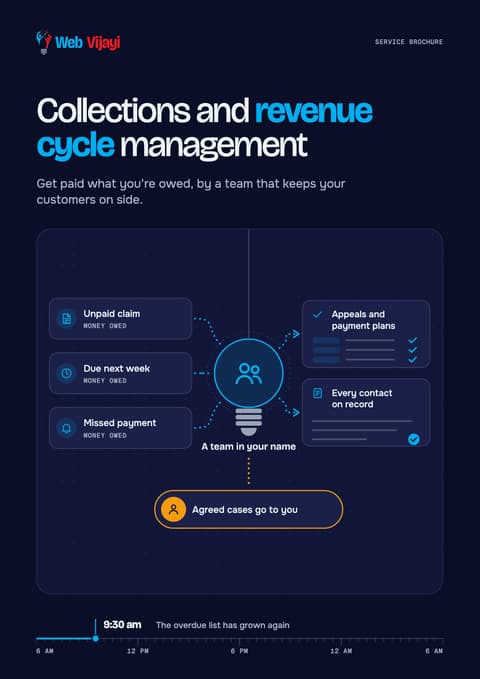
Collections and revenue cycle management
Four A4 pages on how it works, what you get, what we'll need from you and the questions people ask, ready to pass round your team.
Sources
- RBI circular RBI/2022-23/108, Outsourcing of Financial Services: Responsibilities of regulated entities employing Recovery Agents (12 August 2022)2026-11-21
- RBI press release, Amendment Directions on Conduct of Regulated Entities in Recovery of Loans and Engagement of Recovery Agents (6 August 2026)2026-11-21
- RBI notification RBI/2026-27/223 for commercial banks (6 August 2026)2026-11-21
- CFPB, Regulation F, 12 CFR 1006.14 (current version)2026-11-21
- CFPB, Regulation F, 12 CFR 1006.6 (current version)2026-11-21
- FCA FG21/1, Guidance for firms on the fair treatment of vulnerable customers (February 2021)2026-11-21
- HFMA, The KPIs that define revenue cycle excellence (10 April 2026)2026-11-21
- HFMA Claim Integrity Task Force, Standardizing denial metrics for revenue cycle benchmarking and process improvement2026-11-21
- TechTarget RevCycle Management, Breaking down the top 5 healthcare revenue cycle KPIs (14 November 2023)2026-11-21
- 45 CFR 160.103 and 164.504(e), HIPAA business associates (Cornell LII copy)2026-11-21
FAQ
What is the difference between revenue cycle management and debt collection?
Revenue cycle management covers a patient's whole path from booking to final payment. Most of that money comes from insurers, so the hard part is sending clean claims and winning back denied ones. Debt collection starts when a customer has missed a payment, or is about to, and the work is reminders, conversations and payment plans. Both need careful records and fair treatment of the person who owes the money.
Do you contact customers in our name or in yours?
In yours, as part of your own collections, unless we agree otherwise. If you'd rather we collected in our own name, we first check what that would take in each country your customers live in, and we settle it in the consultation before anything goes into a quote.
How do you keep calls and messages within the rules?
The rules for each country go into the playbook before anyone is contacted: calling hours, how often a person may be called, what must be said and how to opt out of messages. In India that means recovery calls only between 8 a.m. and 7 p.m. under RBI rules, and from 2027 banks may contact borrowers outside those hours only when the borrower asks. In the US it means Regulation F's limits on call frequency and inconvenient times. Our quality checks on recorded calls score against those same rules.
Can we outsource only part of the work?
Yes. You choose which parts we take on, from the whole cycle down to one stubborn piece such as claims that have gone unpaid for months. The playbook you sign off sets the point where an account goes back to your own team, so the hand-off is written down before anyone is contacted.
Can you work with US patient data?
Only under a business associate agreement. HIPAA treats anyone doing billing or claims work for a healthcare provider as a business associate, so the agreement is signed before any patient data is shared. It sets the safeguards, how breaches are reported, the terms for any subcontractor and what happens to the data when the work ends.
Will collection calls upset our customers?
Calls can upset people when the tone is wrong, so you sign off every script, message template and contact limit before anyone is contacted, and you can listen to recorded calls where the law allows recording. Anyone who mentions illness, a bereavement, losing their job or another hardship is passed to a trained team member, who offers the options your policy allows. The FCA's guidance in the UK expects firms to spot customers in vulnerable circumstances and check they get fair outcomes, and we report these cases to you separately.
Related
- Back-office outsourcingBack office outsourcing services for data, invoices and admin
- Customer support outsourcingCustomer support outsourcing for phone, chat and email, run to your rules
- Phone support teamsPhone support outsourcing: a trained team for your customers' calls
- Chat and email supportEmail, chat and ticket support teams that work to your rules
- Document processingAI invoice processing into Tally, Zoho Books and spreadsheets
- Predictive analyticsPredictive analytics services that show what is likely next

Pictures are illustrations






Next step
Tell us where money gets stuck today, in claims, denials or overdue accounts, and we'll suggest where a team would help first. In the free consultation we'll also agree which slice of claims or accounts would suit a pilot, so you can compare the results with how things run today.
Book a free consultationLast updated