






Support and back-office teams
Illustration
Phone support outsourcing: a trained team for your customers’ calls
In phone support outsourcing, a trained outside team answers your customers' calls in your company's name.
A free call, then a fixed quote in writing. You don't have to go ahead.

The short answer
Web Vijayi's agents work inside your own systems, from your scripts and knowledge base, note every call and pass anything outside the agreed rules to the person you name. It suits support and operations leaders whose call volumes have outgrown their own team.
The agents work to the rules and service levels you agree, and they can make the outbound calls you approve too. If your phone system is what's holding you back, we can also set up a cloud contact centre for you, or move your existing one onto a cloud platform, so every call is routed, recorded and reported in one place that connects to your CRM.
Key facts
Who is it for?
It's for support and operations leaders at medium and large businesses, usually facing one of these:
Queues that spike with the season, a product launch or an outage, faster than you can hire and train people
An ageing phone system in your own building, or several systems left over after a merger, with no single view of calls
A regulated line of business where calls must be recorded, checked and kept under strict rules
If you have a few calls a day that you miss while you're busy, a voice agent or a better call-forwarding set-up is likely to suit you better than a team. If you need chat and email covered as well as calls, start with customer support outsourcing, or add chat and email support next to the phone team.
What calls can an outsourced phone team handle?
Our agents take your inbound calls: orders, bookings, account questions, complaints and whatever else your callers ring about. They work inside your own systems, from your knowledge base and your scripts, and they pass anything outside the agreed rules to the person you name. We agree the languages they speak and the hours they cover with you before we start.
They can also make the outbound calls you approve, such as callbacks, reminders, follow-ups after a complaint or welcome calls to new customers. Every outbound campaign follows the calling rules of the country it calls into. In the UK, for example, that means checking numbers against the Telephone Preference Service registers, saying who is calling and showing a number people can ring back.
Can you move our calls onto a cloud phone platform?
Yes. We start by writing down what your current phone system really does, including every phone menu and every route a call can take. Then we set the same journeys up on the platform you choose, improved where your call data shows callers getting stuck, and connect calls to your CRM so agents see who is calling. We write the tests while the new journeys are being designed, and run them with a heavy load of calls before and after the switch-over day. Once the new system is live we keep watching where calls go, so a problem shows up before your callers notice it. Your own staff, our agents or both can then work on the same platform. If what you mainly need is a new agent screen for your own staff, see contact centre software.
How it works
We study your calls.
We look at why people call, how many calls arrive each hour, your current scripts and complaints, and recordings if you have them. Together we decide which calls should stay with your own staff.
We agree the rules in writing.
That covers the scripts, what agents may decide on their own, when a call goes to your team, the service levels, the quality scorecard and the data processing contract.
We learn what your experts know.
Your specialists walk us through the exceptions and judgement calls that aren't written down. We write them into the knowledge base, agents listen to real calls with your team, and we test them before they take a live call.
We start with part of your calls.
A first phase might be one queue, set hours, or the extra calls at your busiest times. We widen it only when the measures you set are being met.
We review with you.
You get regular reports, both teams score the same calls and compare, and the scripts and knowledge base change when the calls show they need to.
What you get
Screens are mock-ups
Trained agents on your inbound lines, working from your scripts and your knowledge base
Outbound calls you approve, such as callbacks, reminders and follow-ups
A quality scorecard agreed with you, with calls scored and compared by both teams
A recording and a written note of each call, kept as your data contract says
Regular reports on call numbers, waiting times, why people called and call quality
One named contact who answers for the service and joins your reviews
A cloud contact centre set up and connected to your CRM, with your numbers moved across
How you stay in charge of the work
You approve the scripts, the list of things agents may decide on their own, and which calls go straight to your staff. A change to any of them goes live only after you approve it.
You can listen to any recorded call and read any call note.
You can ask your named contact to change the scripts, hours or call types, or to pause a queue, at any time. You can end the service on the notice terms in your contract, which also set out how your recordings and data come back to you or are deleted.
You stay in control
You may add AI features to your contact centre later, such as written call summaries or a voice agent that answers first and passes the call on. Callers can always ask for a person. Everything we set up works with a person in charge. It can prepare the work and wait for your yes before anything goes out, it passes anything unusual to you or your team, and it keeps a record of what it did. You can check it, change it, pause it or switch it off whenever you like. A voice agent that answers calls has to run by itself. You decide what it may do without asking. It tells you each time it acts, and you can stop it at any time.
What should you check before you hand over your phone lines?
Ask any provider, us included, before you sign.
How will card payments be taken?
We agree the method with you and your payment provider before any payment call is taken. The PCI Security Standards Council's guidance for phone payments says the card security code must never be kept after a payment, even in a recording. It prefers technology that keeps card details out of the recording altogether, for example by masking the keypad tones so the agent can't hear the digits. Pausing the recording while the customer reads out their card helps, but the agent and the agent's screen still handle the card number.
Who controls your customers' data?
You should. The provider acts only on your written instructions, and the UK ICO's guidance lists what that contract must cover: security, staff confidentiality, other companies brought in only with your permission, your right to audit, and the return or deletion of the data at the end.
Which calling rules apply?
That depends on where you call. In the UK, Ofcom expects companies using automatic diallers to prevent silent and abandoned calls, and the ICO sets the rules on marketing calls. Other countries have their own, so we agree which apply before the first call.
Which standards should a provider work to?
ISO 18295-1 sets requirements for contact centres, in-house or outsourced, and ISO 18295-2 covers the companies that hire them. The COPC CX Standard, updated in February 2026, covers human agents and AI together. Ask which ones a provider works to, and ask to see the evidence.
What we need from you
One person on your side who approves scripts, rules and changes
Whatever call data you have: call reasons, calls by hour and recordings from recent months
Your scripts, knowledge base, policies and complaint process
Access to the systems agents will use, such as your CRM, helpdesk or order system, limited to what the work needs
For a platform move, a list of your numbers, details of your current phone system and carrier, and your phone menus
Your data protection terms and call recording rules
Price
Every phone support team and platform project is quoted in writing after a free consultation, with the timeline agreed in the same quote. Platform licences and call charges are listed separately in the quote. Full details on the pricing page.
Download the brochure
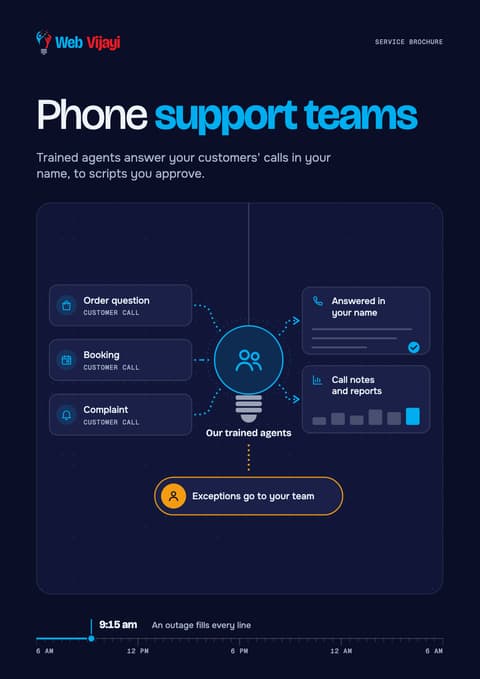
Phone support teams
Four A4 pages on how it works, what you get, what we'll need from you and the questions people ask, ready to pass round your team.
Sources
- BSI Knowledge, BS EN ISO 18295-1:2017, Customer contact centres: requirements for customer contact centres
- COPC Inc., 'COPC Inc. announces the new COPC Customer Experience (CX) Standard Release 8.0'2026-02-11
- PCI Security Standards Council, Information Supplement: Protecting Telephone-Based Payment Card Data, v3.02018-11-01
- UK Information Commissioner's Office, 'What needs to be included in the contract?' (controllers and processors)
- UK Information Commissioner's Office, Guide to PECR: telephone marketing
- Ofcom, 'Refresher messaging on silent and abandoned calls'2026-01-22
- ICMI, 'Calibration Chaos? How to Align on Quality Across Contact Center Teams', Erica Marois2025-06-30
- CX Today, '10 Best Practices for Contact Center Quality Assurance', Charlie Mitchell2024-12-23
- destinationCRM, 'Companies Using GenAI for Customer Service Must Provide Access to a Human Agent' (reporting a Gartner survey)2026-08-18
- No Jitter, '5 Steps for a Seamless Contact Center Cloud Migration', Elizabeth Magill2019-09-08
FAQ
Can your agents use our phone system and CRM?
Usually, yes. Agents work inside your own systems with access you grant, limited to what the work needs, and you can take that access away. If your calls still run on equipment in your building, a cloud contact centre (software that routes, records and reports on calls online) lets your own staff and our agents work from one set of queues and one set of reports.
Should we choose a shared or a dedicated phone team?
Shared agents take calls for several companies, which suits low or uneven call volumes. A dedicated team works only on your calls, which suits complex products and calls that need deep product knowledge. Ask any provider which of the two a quote is based on.
How is call quality checked?
We agree a scorecard with you before launch, with real call examples of what good and poor look like on each line. Calls are scored against it. Your team and ours also score the same calls separately, then compare and settle any differences. We also look at what customers say after their calls, because a score that doesn't match how customers feel means the scorecard needs changing.
Who owns the call recordings and customer data?
You do. We work on your written instructions under a data processing contract. It covers security, staff confidentiality, which other companies may touch the data and only with your permission, your right to audit, and whether the data comes back to you or is deleted when the work ends.
Can we bring the work back in-house later?
Yes. Your contract sets the notice terms. The scripts, knowledge base and call records built for your service are yours, so your own team or another provider can pick them up.
Can AI replace a phone team, and can callers still reach a person?
Software can answer simple, repeated questions and route calls. Complaints, complex problems and urgent calls still need a person, so most companies use both. If you add AI to your phone line later, a caller can always ask for a person. Gartner's 2026 customer research found most customers expect a clear route to a person when a company uses AI in service, and we set lines up that way.
Related
- Customer support outsourcingCustomer support outsourcing for phone, chat and email, run to your rules
- Chat and email supportEmail, chat and ticket support teams that work to your rules
- Technical helpdeskTechnical support outsourcing: a helpdesk your customers can reach
- Pre-sales and post-sales teamsOutsourced lead qualification: fast replies and sales-ready leads
- AI voice agentsAI voice agents that answer calls and pass hard ones to your team
- Analytics and insightsQuality assurance on every call, chat and email
- Collections and revenue cycleCollections and revenue cycle teams that get you paid and keep customers on side

Pictures are illustrations







Next step
Book a free consultation, and bring a month of call data if you have it. We'll talk through which calls to hand over first and what your phone system needs.
Book a free consultationLast updated