






Support and back-office teams
Illustration
Back office outsourcing services for data, invoices and admin
Hand over data entry, invoices, reconciliation and admin to a trained team. A pilot comes first, a sample of work is checked and you get regular reports.
A free call, then a fixed quote in writing. You don't have to go ahead.

The short answer
Back office outsourcing moves the repetitive office work behind your business, such as data entry, bookkeeping, payroll preparation and HR records, to a trained outside team. Web Vijayi runs these teams for companies whose paperwork has grown faster than their staff, working inside your systems and to rules you approve. Your people keep the decisions, and every batch is checked before it comes back.
The team handles the volume and reports to one person you name, and the sign-off stays with your own people.
Key facts
Who is it for?
It's for medium and large businesses where the paperwork has grown faster than the team. Think of a finance department that spends month-end keying invoices instead of reviewing them, or an HR team getting a hiring wave through on top of the usual pay run. It might be an operations manager moving to a new system with years of records to check and load, or a shared service centre that can't recruit as fast as the work arrives.
If the work follows rules you could write down, and there's enough of it to keep people busy, it can usually be handed over.
What can you hand over?
Each of these can be run on its own or together as one service.
BPM services (business process management).
We take on a whole process rather than single tasks: for example, everything from a supplier invoice arriving to it being matched, approved and filed. We write down how it runs today, agree the rules and the targets with you, then run it and report against them.
Data entry.
We key, check and convert records at volume, from forms and orders to product lists, scanned files and old spreadsheets moving into a new system. Key fields are keyed twice by different people or checked against rules, duplicates are cleaned out, and a sample of finished work is reviewed before it goes back to you.
Accounting.
We do the day-to-day bookkeeping: entering and matching supplier invoices, recording what customers pay, reconciling bank and other accounts, and preparing month-end reports. Your finance lead approves payments, journals and anything sent to a tax authority.
HR services.
We handle the admin side of HR, such as new-joiner paperwork and records, payroll inputs checked before each pay run, leave and attendance records, and first replies to routine staff questions. Hiring decisions, pay decisions and anything sensitive stay with your own HR team.
Back-office solutions.
This is the mixed admin that doesn't belong to one department: order processing, stock and inventory records, purchase order matching, updating customer records in your CRM (the system that holds your customer details and contact history) and document filing. It suits tasks that each take a little of many people's time and add up.
Virtual workspace.
A virtual desktop is a computer that runs in the cloud and is reached over the internet. Our team can work inside virtual desktops you control, so your files stay in your environment rather than on our laptops, and access ends the day you remove it. We can also set up virtual desktops, sign-in rules and device controls for your own remote staff.
How it works
We map the work with the people who do it now.
We sit with your team, collect real samples (including the awkward ones), and write the work instructions: what a finished item looks like, the rules, what counts as an exception and who decides it.
We agree the targets and the reports.
That means accuracy and turnaround measures that suit the work, how often you hear from us, and who your named contact is.
We run a pilot on a slice of the work.
A real batch is done alongside your team and checked against their results before anything moves across in full.
We take over in stages and keep reporting.
More work moves across as quality holds. Exceptions come back to the person you choose, and the instructions are updated whenever your rules change.
What you get
Screens are mock-ups
Written work instructions for each process, which you own
A named contact who knows your work and takes responsibility for it
Checks on every batch: double keying or rule checks on key fields, plus a reviewed sample
Regular reports on volume, accuracy, turnaround and open exceptions
A list of exceptions, sent to the person you choose, for anything outside the rules
Access only to the systems and folders the work needs, removed when it ends
A written exit plan for handing the work back to you or to another supplier
How do you stay in charge of the work?
You set the rules and we work to them. Every process runs from instructions you've approved, and anything they don't cover comes back to you rather than being guessed at. Your reports show what was done, what the checks caught and what is waiting for your decision, and your named contact can explain any of it.
You can check the work whenever you like, and hold any batch or item at any time. Nothing you hold goes ahead until you say so. Adding or removing work, or ending a process, follows the notice set out in the contract. Payments, payslips and filings go out only after your named approver says yes.
How is your data protected?
When a supplier handles personal data for your business, UK data protection law says the contract must set out the terms in writing. The supplier acts only on your instructions and binds its staff to confidentiality. It brings in no other firm without your written permission, lets you or your auditor check the work, and returns or deletes the data at the end, as you choose. India's new data protection rules also expect a business to hold its suppliers to the law by contract. Ask to see these terms in the contract before any personal data moves across.
Access follows the advice the UK's National Cyber Security Centre gives for any supplier: only what the work needs, controlled and monitored, with incident reporting set out in the contract. If you're a bank or another regulated firm, expect to need an exit plan and close monitoring for important outsourced work. In the EU, the European Banking Authority's guidelines of September 2026 cover both, so tell us early and the contract can be written to match.
What do we need from you?
A process owner on your side who answers questions and approves the instructions
Real samples of the work, including the cases your team finds hardest
Access to the systems the work runs in, set up the way your IT team prefers
Your rules: approval limits, policies, and who decides exceptions
Time from your team during the pilot, so the results can be compared
Where it fits
Sometimes the better answer is to remove the task. If staff copy the same data between two systems, API integration may get rid of that step. If the pile is mostly invoices and forms, software can read them first and a person checks each one. That's our document processing service, and it can sit underneath the team. To protect your own remote staff beyond the workspace, see cybersecurity as a service.
If your team wants simple screens to approve and track the work, no-code internal tools can give them dashboards and admin panels. And if your customers need people to answer their technical questions, see our technical helpdesk.
Price
Every engagement is quoted in writing after a free consultation, with the timeline agreed in the same quote. The quote sets out the work covered, how it's billed and the notice to change or end it. You'll find full details on the pricing page.
Download the brochure
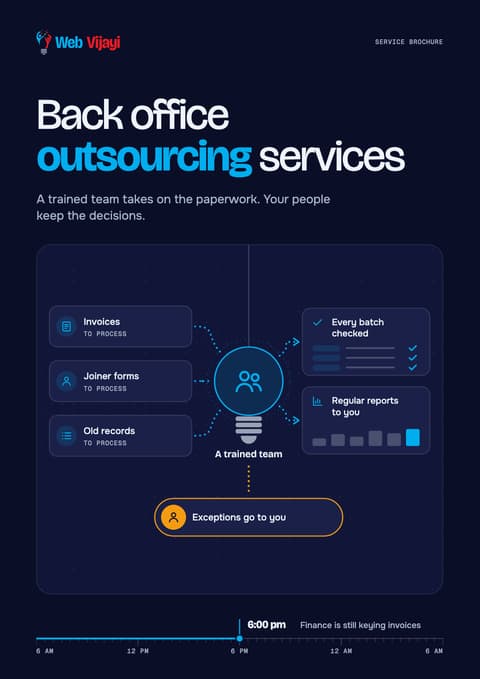
Back office outsourcing services
Four A4 pages on how it works, what you get, what we'll need from you and the questions people ask, ready to pass round your team.
Sources
- ICO: what needs to be included in a controller and processor contract2026-11-21
- GOV.UK: PAYE and payroll for employers, choosing how to run payroll2026-11-21
- UK Government: the Sourcing Playbook2026-11-21
- NCSC: supply chain security, establish control2026-11-21
- European Banking Authority: final Guidelines on the management of third-party risk2026-11-21
- Hogan Lovells: India's Digital Personal Data Protection Act brought into force2026-11-21
- Microsoft Learn: what is Azure Virtual Desktop?2026-11-21
FAQ
What is back-office outsourcing?
It's handing the repetitive office work behind a business, such as data entry, bookkeeping, payroll preparation and HR records, to an outside team that does it to your rules. The work stays in your systems and your people keep the decisions. The team does the volume and checks it, then reports to you.
Who is responsible if a payment or a payslip is wrong?
Your business keeps responsibility for its own accounts and payroll. In the UK, for example, GOV.UK says an employer is legally responsible for all PAYE tasks even when it pays someone else to do them. So we prepare and check, and nothing is paid or filed until the person you name has approved it. If your auditors want an independent report on the controls of any supplier that touches your accounts, raise it in the first call and we'll tell you what we can provide.
Can we start with a small part of the work?
Yes, and we recommend it. A pilot on one real batch, run alongside your own team and checked against their results, shows whether the instructions and the checks hold before more work moves across. The UK government's sourcing guidance recommends a pilot before any first-time outsourcing for the same reason.
How is the quality of the work checked?
Every batch is checked before it comes back to you. Key fields are keyed twice by different people or checked against rules, and a sample of the finished work is reviewed. Your reports show volume, accuracy, turnaround and open exceptions. Accuracy checks are most reliable when someone other than the person who did the work makes them.
What happens if we want to bring the work back in house?
The exit is planned in writing at the start. You already own the work instructions, so your team or another supplier can pick them up. At the end we return or delete your data, whichever you choose, and our access to your systems is removed.
How much does back-office outsourcing cost?
Every engagement is quoted in writing after a free consultation. The price depends on the processes, the volume, how fast the work has to turn round and the systems involved. The quote also sets out how the work is billed and the notice needed to change or end it.



Next step
Book a free consultation. Bring one process you'd like off your team's desk, a few real examples and a rough count of how many come in each month, and we'll tell you plainly whether it suits an outside team and how a pilot would run.
Book a free consultationLast updated