






Support and back-office teams
Illustration
Customer support outsourcing for phone, chat and email, run to your rules
With customer support outsourcing, a trained outside team answers your customers by phone, chat and email, working in your helpdesk wherever possible and to your written rules.
A free call, then a fixed quote in writing. You don't have to go ahead.

The short answer
Customer support outsourcing suits companies whose own support team can't keep up after a launch, at weekends or in a new market. Web Vijayi agrees the service levels with you, and you keep the final say on anything that matters.
The team can also answer customers on messaging apps. You keep the customer relationship, and anything unusual goes back to your own staff. We recruit and train the team and check its work against a scorecard you agree, then report to you on what customers asked and how quickly they got help.
Key facts
Who is it for?
It suits a medium or large business whose own support team can no longer keep up. Queues build after a launch or a price change, evenings and weekends go unanswered, and each new market brings another language and time zone. Hiring and training in-house for every peak is slow, and the people you hire sit idle when the peak passes.
It also suits companies that want their own staff on the hard cases, such as complaints, key accounts and large refunds, while a trained team handles the everyday questions. If your contact volume is small and steady, one more hire in-house is often simpler, and we'll tell you so in the consultation.
What does customer support outsourcing cover?
It comes in three forms, from one team on the channels you pick to the running of your whole support operation, and there are specialist teams you can hire on their own. If one busy queue is the problem, customer engagement is the place to start. Choose omnichannel service when customers move between channels and end up explaining themselves twice, and CX solutions when you want us to run the whole operation, from hiring to reporting.
Customer engagement: one team for your calls and messages
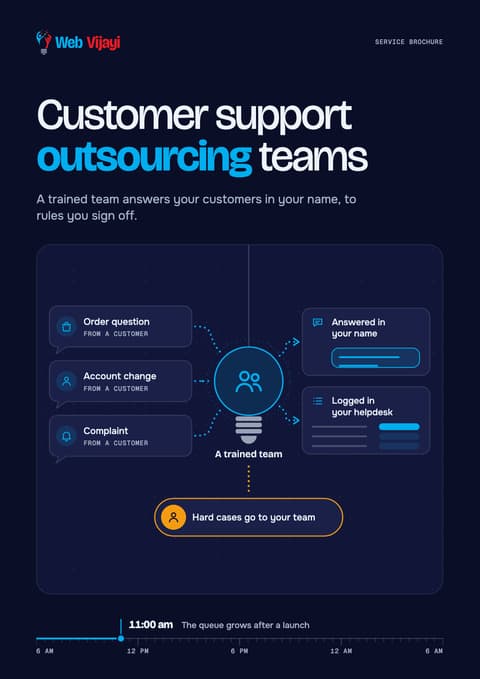
Customer engagement is the core service. It's a team that talks to your customers for you, on the phone and in writing. You decide which contacts it takes, from order questions and account changes to complaints, and which always come back to your own staff. Agents use your brand name, your tone and your approved answers, and every contact is logged, in your own helpdesk or CRM wherever possible.
Omnichannel customer service: every channel, one history
Customers switch channels. Someone emails, waits, then phones, then sends a message on social media. Omnichannel customer service means one team works all of those channels from one record of the customer, so the agent who picks up the phone can see yesterday's email and the customer doesn't have to explain twice. That only works if every channel feeds the same helpdesk or CRM, so checking this is part of the set-up.
If a chatbot already answers routine questions on your site, our agents take the chats it passes on, with the conversation so far. Customers expect a clear way to reach a person, so we test that handover before launch. For a new chatbot, see AI chatbots. You stay in control of that handover: you can check any chat the chatbot passes on, and pause or stop the handover at any time so chats come straight to our agents.
CX solutions: the whole support operation, run for you
CX solutions (CX means customer experience) is the full package. Instead of buying one channel at a time, you hand us the running of your support operation to an agreed standard. That covers hiring and training, staffing to your forecast, quality checks, reporting, and regular reviews of why customers keep getting in touch, so the causes can be fixed where they start. Your team keeps ownership of policy, refunds and anything that changes what you promise customers.
The specialist teams
- Phone support teamsInbound calls, call-backs for missed ones, and calls to customers who are expecting them.
- Chat and email supportWebsite chat, messaging apps and your support inbox, answered in your brand's voice.
- Technical helpdeskFirst-line and specialist help for your product's users, with every ticket tracked to agreed response times.
- Sales support teamsQuick replies to new enquiries, lead qualification, onboarding calls and renewal reminders.
- Back-office outsourcingData entry, bookkeeping, payroll inputs, HR admin and order processing, done in your systems to rules you approve.




Pictures are illustrations
How it works
We study your contacts.
You share a sample of recent calls, chats and emails, your volumes by hour, day and season, and the processes agents must follow. Together we sort which contacts the team can own and which must reach your staff.
We agree the rules and the measures.
We write the scripts, the escalation rules and a quality scorecard with you, and agree service levels: how fast each channel is answered and resolved, and how each is measured. These go into the contract.
We set up access and train the team.
Agents get accounts in your helpdesk and CRM with only the permissions they need. Training covers your products, your policies and practice contacts, and nobody goes live until they pass a test you have seen.
We start small.
A pilot on part of your volume, often one queue or one channel, shows whether the team meets the pass marks. You decide when to hand over more.
We run, check and report.
Reviewers score a sample of contacts against the scorecard, we compare scores with your team in calibration sessions, and you get regular reports and review meetings.
See how it works
A trained outside team that answers your customers. They use your name, your tone and your approved answers.
Read the transcript
Every launch, the queue grows and calls go unanswered. Hiring for every busy spell is slow, then new staff sit idle.
A trained outside team that answers your customers. They use your name, your tone and your approved answers.
Share real calls and emails from your customers. Scripts and hours are agreed before we start. The team learns your products and your policies.
You stay in control. Anything unusual goes to the person you name. You can read or hear any contact. Pause or end the work on agreed terms.
Scripts and rules signed off by you. All conversations logged. History stays yours. Regular reports and a named contact.
Who answers your customers when the queue grows? Talk to us.
What you get
Screens are mock-ups
A trained team that answers your customers in your name, on the channels you choose
Scripts, answers and escalation rules written with you and signed off by you
Every contact logged, in your own helpdesk or CRM wherever possible, so the history stays with you
Quality checks against a scorecard you agree, with calibration sessions alongside your team
Regular reports on volumes, response times, resolution and the reasons customers get in touch
A named contact who answers for the service and runs the review meetings
Cover planned to your forecast, including launches, sales and seasonal peaks
A written exit plan, so the work can come back in-house or move on without a gap in service
What should the contract cover?
ISO 18295, the international standard for customer contact centres, has one part for the centres themselves and a second for the companies that hire them, setting out what stays the client's job, from customer data to measuring quality. Whoever you hire, the contract should cover at least the points below.
Service levels for each channel.
How fast contacts are answered and resolved, and exactly how that is measured.
The quality scorecard.
What good looks like for each item, and how often the scorecard is reviewed.
Data terms.
Under UK and EU data protection law, an outside team handling your customers' personal data may act only on your documented instructions, must keep it confidential and secure, may use subcontractors only with your agreement, and must return or delete the data when the work ends.
Audit and access rights,
so you or your auditor can check how the work is done.
An exit plan
that sets out the handover, the timings and what happens to the data.
If you're a bank, insurer or lender, your regulator will expect more. The UK's Financial Conduct Authority is clear that a firm stays responsible for anything it outsources, and the European Banking Authority's September 2026 guidelines ask for documented exit plans and audit rights for important services. We work through these with your risk and compliance team before signing.
How do you stay in charge of the work?
Our agents follow the rules you sign off, and you can check their work and change or stop it.
Agreed scripts and rules.
Agents follow scripts, answers and escalation rules you have signed off. Anything outside them, such as a refund above your limit, a legal threat or an upset key customer, goes to the person you name.
Reporting you can check.
You get regular reports, and you can read any chat or email and listen to any recorded call yourself, not only the ones we choose to show you. When our agents work in your own helpdesk and phone system, as they do wherever possible, those records are already there.
A named contact.
One person on our side answers for the service, joins your review meetings and fixes the problems you raise.
Changes on your word.
When a price, policy or product changes, you tell us, and we update the scripts and brief the agents before they answer customers about it. You can add or remove channels and scale the team up or down within the notice agreed in the contract.
A way to pause or stop.
You can pause or end the work on the terms in the contract, and the exit plan written at the start sets out how knowledge, recordings and data come back to you.
What we need from you
Recent examples of real calls, chats and emails, and your volumes by hour, day and season
Your current answers, policies and knowledge base, even if they are out of date
Access to your helpdesk, CRM and phone system, with accounts set up for our agents
One person on your side who signs off scripts and takes the escalations
Your rules on data: what agents may see, store and say, and any industry rules you work under
Time with your experts in the first weeks, because the hardest answers usually live in someone's head
Price
Every support service is quoted in writing after a free consultation, because the price depends on the channels, hours and languages you need and how many contacts you get. The timeline, including any pilot, is agreed in the same quote. Full details are on the pricing page.
- Paid separately
- Phone lines and software licences, if any
Download the brochure
Customer support outsourcing teams
Four A4 pages on how it works, what you get, what we'll need from you and the questions people ask, ready to pass round your team.
Sources
- BSI, BS EN ISO 18295-2:2017, Customer contact centres: requirements for clients using the services of customer contact centres
- Financial Conduct Authority, Outsourcing and operational resilience2026-07-14
- Information Commissioner's Office, What needs to be included in the contract (controllers and processors)
- European Banking Authority, final Guidelines on the management of third-party risk2026-09-18
- ISG, Making the move: top strategies for managed services transitions2025-04-29
- ICMI, Calibration chaos: how to align on quality across teams2025-06-30
- destinationCRM, report on Gartner's 2026 customer research on generative AI in service2026-08-18
- COPC, CX Standard Release 8.0
FAQ
Who owns the customer data when an outside team handles our support?
You do. Our agents work in your helpdesk and CRM wherever possible, so the records stay in your systems. Before anyone sees customer data we sign a written data agreement that says what they may do with it, how it is kept secure, who else may touch it and how it is returned or deleted when the work ends.
Which parts of support can we outsource, and can we start small?
Any channel can go to an outside team, from phone and chat to email tickets. Many companies hand over the everyday questions and keep the contacts that change what they owe a customer in-house: refunds above a set amount, legal complaints, key accounts and anything a regulator watches closely. We map this with you before anything starts. We also recommend a pilot on one queue or one channel, with pass marks agreed in advance, which shows whether the team handles your customers well before you hand over more. You decide when to add the next channel.
What should a customer support SLA include?
An SLA (service level agreement) should set how fast each channel is answered and resolved and exactly how that is measured, plus the hours covered, quality checks, escalation steps and reporting. It should also say what happens when a target is missed. We agree the service levels with you and write them into the contract.
How do you check the quality of the work?
Reviewers score a sample of calls, chats and emails against a scorecard you sign off. We run calibration sessions with your team, where both sides score the same contacts and compare, so we judge the work the same way you would. You can also read or listen to any contact yourself, in your own systems wherever our agents work in them.
What happens if we want to bring support back in-house or move to another provider?
We write the exit plan at the start, while everyone is on good terms. It covers how the knowledge base, scripts, recordings and data come back to you, how long both teams overlap and who does what during the handover.
How much does customer support outsourcing cost?
We quote every service in writing after a free consultation. The price depends on the channels, the hours and languages you need, how many contacts you get and how complex they are. Phone lines, software licences and other running costs are listed separately in the quote.
Related
- Phone support teamsPhone support outsourcing: a trained team for your customers' calls
- Chat and email supportEmail, chat and ticket support teams that work to your rules
- Technical helpdeskTechnical support outsourcing: a helpdesk your customers can reach
- Pre-sales and post-sales teamsOutsourced lead qualification: fast replies and sales-ready leads
- Back-office outsourcingBack office outsourcing services for data, invoices and admin
- AI chatbotsAI chatbot development for your website and WhatsApp
- AI voice agentsAI voice agents that answer calls and pass hard ones to your team
- AI-assisted CRMA unified agent desktop: one screen for every customer conversation
- Analytics and insightsQuality assurance on every call, chat and email
- Collections and revenue cycleCollections and revenue cycle teams that get you paid and keep customers on side

Pictures are illustrations










Next step
Book a free consultation. Bring a rough count of your monthly contacts by channel and the questions customers ask most, and we'll tell you plainly which parts suit an outside team and which should stay with your staff.
Book a free consultationLast updated