
Data for AI teams
Illustration
Data annotation services for images, video, audio and text
Trained people label your images, video, audio and text to guidelines you approve, with a pilot first and agreement and error figures in every report.
A free call, then a fixed quote in writing. You don't have to go ahead.

The short answer
Data annotation adds labels to raw data, such as boxes round cars in camera footage, speaker turns in call recordings or categories on support tickets, so a machine learning model has examples to learn from. Web Vijayi's trained annotators do this for computer vision, speech and data science teams building their own models, working to written guidelines you approve.
Key facts
Your data
Who is it for?
It's for teams at medium and large companies who are building their own models and have more raw data than their own people can label. That includes computer vision teams in retail, logistics, manufacturing, farming and transport, speech teams working with call recordings, and data science groups with documents, tickets or product records to sort.
It also suits a team whose labels came back inconsistent from several suppliers or from crowd work and now need checking against one set of guidelines. Where a label needs a licensed expert to decide, such as a doctor reading a scan, we agree with you who does that review before we quote.
What can we label for you?
We label images, video, 3D scans, audio and text to written guidelines you approve, check the labels with hidden test items and a second review, and deliver them in the format your training code reads. Our annotation services cover:
Data annotation for text, documents and records.
We tag documents, emails, support tickets and product records with the categories, names and fields your model needs, such as the supplier, date and total on an invoice or the reason behind a complaint. Every tag has a written definition, so two annotators reading the same item should reach the same answer.
Computer vision annotation for images.
Annotators draw boxes, outlines, pixel-level masks and key points on photographs, so a vision model learns what each object is and where it sits. You choose the shapes and the list of classes, and we agree up front how to treat the hard cases, like objects cut off at the edge of the frame or half hidden behind something else.
Video annotation in 2D and 3D.
In video, each object keeps one ID from frame to frame: a person marks the frames where it moves or changes, the labelling tool fills in the frames between, and the person checks the result. In 3D scans from LiDAR and other depth sensors, objects get 3D boxes that keep the same size and ID across frames and are checked against the camera views where you have them. This only works if the sensors were calibrated and time-matched when the data was recorded, so we check that first.
Audio annotation.
We mark who spoke when, write timestamped transcripts, and tag emotion, background noise and sounds such as alarms or a door closing. Rules for filler words, people talking over each other and words nobody can make out are agreed before the first file, because every dataset treats them differently.
Tools for labelling.
We can work inside the labelling tool you already run, on accounts you control, or agree a tool with you and set it up. Either way, the export format and the shapes are fixed before work starts, because many formats hold only some kinds of shape, and some can't hold video tracks.
How it works
You send a sample and the goal.
That means a batch of your real data, including the awkward items, plus what the model should learn and the format your code reads.
We write the guidelines with you.
Every label gets a definition, when to use it, when not to, and examples of right and wrong answers. You approve the guidelines before anyone labels for real.
We run a pilot batch.
A small batch is labelled and scored against a gold set: items whose answers your team has checked. Where annotators disagree, the rule is usually unclear, so we fix the guidelines before the volume goes up.
We label in batches, with checks at three levels.
Automated checks catch mechanical errors, such as a box outside the image, a 3D box floating above the road or a timestamp past the end of the file. Hidden gold items keep testing every annotator, a second person reviews every item or an agreed sample, and disagreements go to a senior reviewer.
We deliver each batch with a report.
The labels arrive in the agreed format with figures for agreement and errors, the most common mistakes and any guideline changes. You can send a batch back with the items you disagree with.
We hand over at the end.
You get the final guidelines, the gold set and the full log of questions, and your data is returned or deleted as the contract says.
What you get
Screens are mock-ups
Labelling guidelines written with you, with examples and a version number
A pilot batch scored against a gold set before full volume starts
Labelled data in the format your training code reads
A quality report with every batch, showing agreement, errors found and guideline changes
A log of every question annotators raised and how it was decided
Your data returned or deleted at the end, confirmed in writing
How is label quality checked?
A model learns from a wrong label just as readily as from a right one, so most of the work is in the checking. The usual checks are a gold set, an agreement score and an error rate. A gold set is a batch of items with checked answers, mixed into the work without notice, which shows how often each annotator gets them right. Agreement compares annotators who labelled the same items, and when it is low the cause is usually an unclear rule. The error rate comes from a senior reviewer checking a random sample of finished work.
We report all three. A 2024 study of 591 published datasets found frequent mistakes in how agreement and error rates were calculated, so each report also shows how we worked them out. The targets are agreed with you for each project, because a driving dataset where safety is at stake needs a higher bar than tagging a product catalogue.
Annotators can flag any item they are unsure about instead of guessing. Every question and the answer it got goes into the log you receive.
You stay in control
You approve the guidelines before labelling starts, and no rule changes without your sign-off. A named contact runs your project, answers your questions and sends the report with each batch. Anything unusual, such as an item the guidelines don't cover, goes to the person you name on your side to decide. You can open any batch, check any item and send back what you disagree with.
If a model draws first-pass labels to save time, that is your choice. A person checks and corrects every one before it reaches you, and you can switch the model off at any time.
Between batches you can change the guidelines, the volume or what comes first. You can pause or stop the work with the notice agreed in the contract.
How is your data kept safe?
The contract says what we may do with your data and limits us to that. We work only on your written instructions, everyone on the project is bound to confidentiality, and no other company handles the data unless you agree in writing. You can audit how we handle it.
Before you send data, remove names, faces, number plates or account details that your model doesn't need. Anything personal that remains is treated as personal data under the law that applies to you, and at the end of the project it is returned or deleted.
If your system counts as high-risk under the EU AI Act, Article 10 asks for records of how its training data was prepared, including annotation and labelling. The approved guidelines, the gold set and the batch reports are the records your team can point to.
What do we need from you?
A sample of real data, and what the model should do and where it will be used
Someone on your side who can rule on hard cases while the guidelines settle
A gold set, or time from your experts to check one with us
The export format, and the labelling tool you want us to use, if any
Your data protection terms, with personal details removed where the model doesn't need them
Where it fits
Labelling is one step in getting data ready for a model. To collect new recordings or photos first, or to transcribe speech at volume, see training data collection. To adapt a language model on your own examples, see LLM fine-tuning, and to test a model before launch, see AI evaluation and red teaming. If your raw data sits in many systems, big data services can bring it together first. For help building the model itself, see machine learning consulting.
Price
Every project is quoted in writing after a free consultation, with the timeline agreed in the same quote. The price depends on the type of data, how detailed the labels are, the volume and how deep the checks go. A paid labelling tool, if you choose one, is paid separately. You'll find full details on the pricing page.
Download the brochure
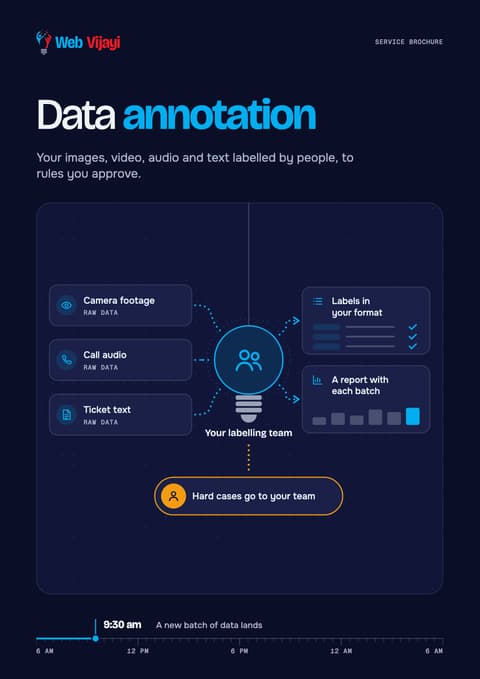
Data annotation
Four A4 pages on how it works, what you get, what we'll need from you and the questions people ask, ready to pass round your team.
Sources
- EU AI Act, Article 10: data and data governance2026-11-21
- ISO/IEC 5259-4:2024, data quality process framework for analytics and machine learning2026-11-21
- ICO, AI audit toolkit: contracts and third parties2026-11-21
- Analyzing Dataset Annotation Quality Management in the Wild, Klie, Eckart de Castilho and Gurevych, Computational Linguistics 20242026-11-21
- Partnership on AI, Responsible Data Enrichment Sourcing Library2026-11-21
- CVAT documentation: track mode2026-11-21
- CVAT documentation: dataset export formats2026-11-21
- Kognic, how to annotate LiDAR data: a best practices guide2026-11-21
- NVIDIA NeMo documentation: speaker diarisation datasets2026-11-21
- Google Machine Learning Crash Course: data characteristics2026-11-21
FAQ
What is data annotation?
It's adding labels to raw data so a machine learning model has examples to learn from: boxes and outlines on images, tracks through video, 3D boxes in LiDAR scans, speaker turns and tags on audio, and categories or fields on text. Annotation and labelling (spelt "labeling" in the US) mean the same thing in practice.
How do you check that the labels are right?
We use three checks together. Hidden test items with checked answers (a gold set) are mixed into the work, annotators who label the same items are compared, and a senior reviewer checks a random sample of finished work to find the error rate. Each batch report shows all three and how each was worked out.
Why run a pilot batch first?
A small batch shows where the guidelines are unclear and how the hard cases get handled. You see agreement and error figures on your own data, and unclear rules are fixed before the volume goes up.
Can we take the labels and guidelines with us?
Yes. The labels come in the export format agreed before work starts, and at the end you get the final guidelines, the gold set and the full log of questions. Whoever you work with, agree the export format and the end-of-project terms before signing, or you can lose the history behind your labels.
Can you work inside our own labelling tool?
Yes, if you give our annotators accounts. The data then stays on your system and you decide who can open it. If you have no tool yet, we agree one with you and set it up.
Do you use AI to pre-label?
Only if you want it. A model can draw first-pass labels for people to correct, which can save time on large batches. A person checks and corrects every one before it reaches you, and you can switch the model off at any time.
Which formats can you deliver?
We agree the format before any labelling starts. Common choices are COCO, YOLO or Pascal VOC for images and RTTM files for who spoke when in audio. Fixing it early matters, because each format holds only some kinds of shape, and some can't hold video tracks at all.
How much does data annotation cost?
Every project is quoted in writing after a free consultation. The price depends on the type of data, how detailed the labels are, the volume and how deep the checks go.
Next step
Send us a small sample and tell us what the model should learn. We'll show you how we'd start the guidelines.
Book a free consultationLast updated